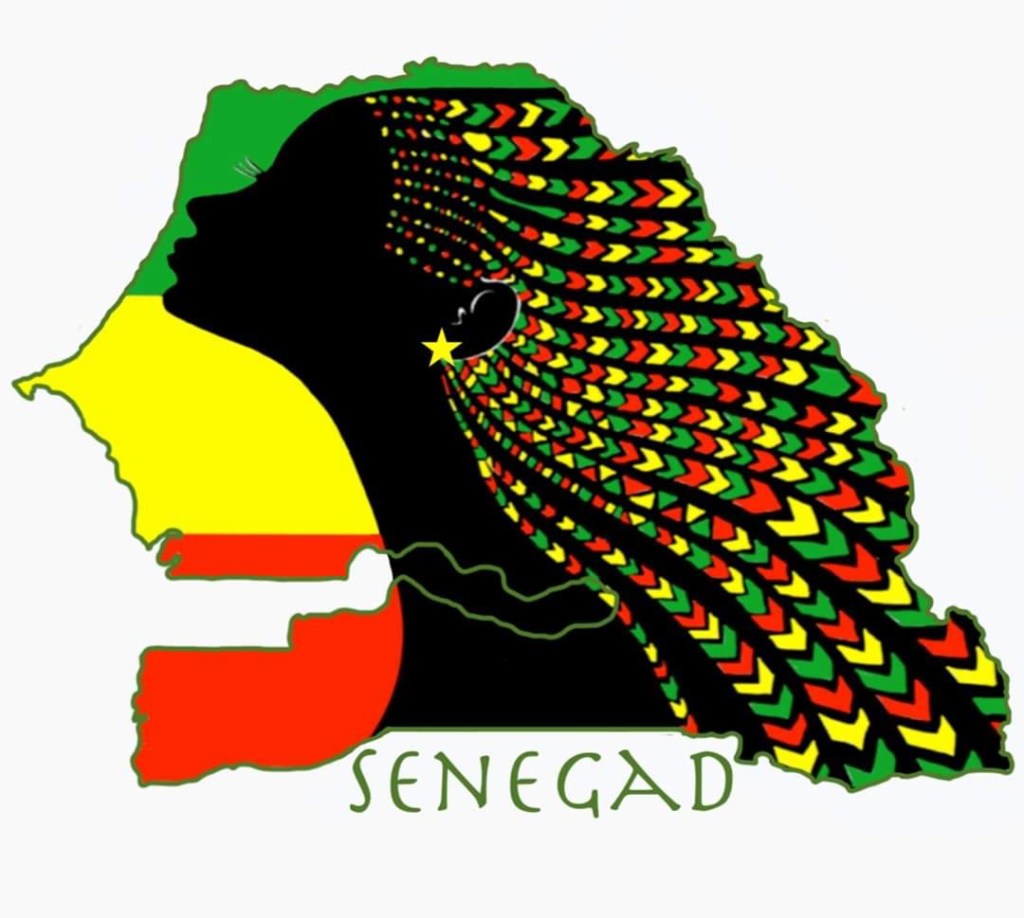
On March 8th, the entire world celebrates International Women’s Day. But here in Peace Corps Senegal, we celebrate women for an entire month with MarchGADness—a competition put on by Peace Corps Senegal’s Gender and Development committee, SeneGAD. Throughout the month, volunteers will compete to hold trainings, defy gender expectations, and share our experiences and activities across social media. I’m starting with a head start by winning this year’s logo competition. But I still hope to do a lot more work to highlight gender work in Senegal. To start, I wanted to share some of my observations about gender in Senegal.
I want to start with noting that my observations will mostly come from experiences living in a Pulaar community. The Pulaar ethnic group is considered more conservative than other Senegalese ethnic groups and is entirely Muslim. From my brief time in major cities like Dakar and Thies, these observations are not necessarily the same as there are different ethnic groups, less conservative relationships between men and women, it’s more “Westernized,” and there is more wealth.
Polygamy & Marriage
As I’ve mentioned before, polygamy is common here with men being able to take up to four wives. In my family, there are two wives. I do want to stress that not every family partakes in polygamy. For instance, in my training family, there was only one wife. But, as my language teacher joked, “Your father is not a strong man. He can’t handle more than one wife.”
There are several reasons people engage in polygamy. For example, if a man’s first wife is unable to conceive children, he will often marry again. Not being able to have children can be very shameful and embarrassing for women here when women often have five to six children. My training mom had 11 children.
Additionally, if a woman is widowed, it is expected that she marry again because it is assumed that she cannot financially support herself and her children. The brothers of her deceased husband—who are often already married—will sometimes offer to marry the woman so that she stays in the family. When my language teacher’s husband died many years ago, her brothers-in-law offered this, but she refused. For some people in Senegal, this can be controversial, but it is something still practiced.
For others, polygamy can be a sign of status and wealth. According to the Quran, a man can have multiple wives as long as he treats them equally and can provide for them all. It is a sign that a man may be of wealth if he can show that he can provide for multiple households with multiple wives and many children.
Sometimes people ask about why a woman would agree to be in polygamous marriages. For many women, marriage is the only option. Many are uneducated (about half of Senegal—both men and women—is illiterate) and have very limited means of providing for themselves. Additionally, it is socially expected for women to marry—usually between the ages of 16-20 unless they go to university. Even if a woman goes to university, it is expected that it is a way to find a man to marry. Within the first minute of a conversation with someone new, I can expect to be asked if I am married or not. Marriage is not seen as optional but a necessity and expectation of all women in Senegal. The question is not will a woman marry but if she will be the only wife or not.
Gender Roles
As I mentioned, women usually marry in their late teens or early 20s. However, that is not true for men. Men usually marry in their late 20s. It is often emphasized that women are adults by 16, but men aren’t adults until they’re at least 26. One of the host brothers of a volunteer highlighted that even the male volunteers are still children while his volunteer sister and I are adults because of our ages.
My counterpart as well as multiple women have said to me before, “Being a woman hurts.” Chores here are much more laborious. Washing laundry by hand takes hours and, as I’ve learned from experience, can cause the skin of your hands to peel off. Being in a desert means a constant battle with dust and dirt covering everything you own. Additionally, cooking a single meal will take two to three hours easily of crushing, cutting, and stirring over the fire in 110 degree heat.
Women are expected to take on household duties and chores much younger. For instance, my middle school aged sister is beginning to take on more responsibility, sometimes cooking meals for the whole family. My sisters and moms take turns doing the entire family’s laundry. In my training family, my sisters were each assigned different takes with one sister in charge of all cooking and another sister managed all of the cleaning. My youngest sister—primary school aged—was beginning to do cleaning chores.
Women are able to work and seek employment. But, for most women, it is a means to make some money on the side, not a career. Women in my community sell unused produce from their gardens, have sandwich stalls, sell imported fabric, or make and sell refrigerated products. There are women with careers, such as my sister who is studying to be a pharmacist or the Peace Corps female local staff that are teachers, managers, or work in the administrative side. But that is not the rule, especially because these women I mentioned had access to a full education.
For schools here, each student has to pay tuition at the beginning of the school year. In families with multiple children and limited means, girls are the first to be cut from school. Sometimes the girls are needed at home to do household tasks. For instance, my training mom had several health issues so that is why my eldest sister managed the household. Also, not all villages have schools and sometimes have to go multiple villages over in order to attend school, so sometimes it is too logistically difficult for children to go to school. Even if a girl completes all her schooling, her family may not allow her or is unable to support her attending university. Most formal career paths I’ve seen required university and French-speaking ability. Additionally, around the completion of high school equivalent is the time period many women get married and start having children. It’s very normal for women to have their first child around 18.
On the reverse side of all of this, there is a very real expectation that men will provide for their families. A man’s income needs to cover his wife/wives and several children. My family has I believe 14 children. In my community, the vast majority of men work in animal husbandry, but there are other paths with a large government presence in my community (though most of these officials are not from Ranerou and often aren’t Pulaar), a whole street of stores and boutiques, and multiple schools. For instance, my dad manages the garage, which is where all transportation in and out of Ranerou comes through.
Additionally, many men leave Ranerou or even Senegal and work elsewhere, sending money back home to provide for their families. The Pulaar ethnic group comprises the majority of Senegal’s diaspora, providing wealth. Many stores owners in cities are Pulaar because they have the capital available from family overseas to invest in starting businesses or they do work with importing and trading.
While I am more aware of women’s issues and fighting for equality and equity, I’m aware that there is hardships on all sides and most do not benefit from the segregation and intense hierarchy of gender. As a volunteer, my job is not to judge or revolutionize the system or culture but, as I will do with my work this month, raise awareness, provide examples in contrast to the status quo here, and empower others to make the decision for themselves as to how they will live their lives. The observations I’ve provided on gender in Senegal are just a portion of my daily life here and what I’ve learned and experienced. If anyone has further questions about gender here, please feel free to reach out and ask questions.
At the end of the month, I will provide more updates on my work this month as well as other cultural insights. Haa gongol!
 Rainbow Sandals in Senegal